My dissertation explores the practices surrounding the Treatise on the Albion, which describes a computing instrument called “albion”, during the 14th century.
As an instrument, the albion, is composed of multiple parts:
Mother
The mother of the albion is a circular brass plate with two faces, on which the different parts of the instrument are riveted
Limb $ehi$
The edge of the first face of the mother forms a ring $ehi$, whose inside is the circle inscribed in the square inscribed in the disc formed by the mother.
Plate $pgq$
The space available on the first face inside of the limb can be filled by a first removable plate $pgq$. This plate itself has a recto and a verso, and can rotate around the mother's centre. The recto of this plate holds figures required to compute planetary positions, while the back is dedicated to eclipse computations.
Limb $lmn$
The edge of the reverse of the mother is raised with a second ring $lmn$, whose breadth is one third that of the first limb $ehi$.
Plate $ros$
As in the first face, the space available inside the limb $lmn$ can be filled with a removable plate $ros$. The recto from this plate contains a spiral used to compute mean motions, while the verso is used for instruments of spherical astronomy (like an astrolabe or a saphea).
Accessories
Finally, other parts are added to tie every piece together, and to help handling the instrument (sighting pinnules, suspension rings, strings, etc.).
As it is often the case with astrolabes, the central space available on each of the mother's faces when the plates are removed can also be used to engrave more elements, therefore increasing the computational capabilities of the instrument.
Building the albion
It is not easy to study the Treatise on the Albion without access to a physical albion. Indeed, practices associated with this text obviously involve handling this instrument. Luckily, the second part of the text provides the instructions required to build a version of this instrument.
et eidem circulo maximum quadratum inscribere quod sit ⋅abcd⋅
Part 2,
Chapter 1
fiat circulus equalis maximo circulo inscriptibili quadrato ⋅abcd⋅
et sit iste circulus ⋅pgq⋅
Limb $ehi$
Part 2,
Chapter 2
incipientes a divisione limbi maioris protrahamus occulte diametrum ⋅agc⋅
et partem diametri que cadit in limbo ⋅hi⋅ dividamus in ⋅10⋅ partes equales
et faciamus per quamlibet divisionem transire circulum unum super ⋅g⋅ centrum descriptum
Et habeat quodlibet spacium inter duos circulos extra se unam brevem marginem pro divisionibus graduum capiendis
excepto secundo spacio quod habebit marginem intra se
Zodiac
Part 2,
Chapter 2
Deinde tercium marginem, numerando ab extra, dividamus fideliter in 360 partes equales
et spacium eius sequens et senas partes equales pro litteris graduum inscribendis
et describamus gradus marginis in ⋅12⋅sig⋅
et in spacio primorum ⋅6⋅gra⋅ cuiusvis signi intituletur numen signi illius
vel in spacio ultimorum ⋅6⋅gra⋅ distincte scupetur quocum fuerit illud signum
In residuis autemspaciis ⋅6⋅gra⋅ eorum numeri insculpentur
et incipiat numerus signorum ex opposito ⋅c⋅ ad punctum ⋅a⋅
Solar year
Part 2,
Chapter 2
a puncto eius in margine quod est in directo ⋅a⋅ separabimus contra naturalem successionem signorum unum arcum ⋅5⋅gra⋅10⋅min⋅27⋅sec⋅ qui sit in extimo margine arcus ⋅ax⋅
et totam residui marginis, scilicet arcum ⋅acx⋅ dividamus in 360 partes equales
et si fideliter sit divisum arcus ⋅xa⋅ de eiusdem partibus continebit ⋅5⋅par⋅et quatram unius
vocabiturque circulus primus anni solis
Altitude
Part 2,
Chapter 2
semicirculum eius ⋅bad⋅ dividemus in ⋅90⋅ partes equales
et spacium marginis proximi in ⋅18⋅ et inscribantur numeri graduum incipientes apud ⋅d⋅ versus ⋅a⋅
semicirculus ⋅dab⋅ vocabitur altitudinis
Arc of hours
Part 2,
Chapter 2
Reliquam vero medietatem marginis in 12 partes equales secemus, quas 12 horas in spacio margini proximo titulabis
Quamlibet illarum 12 parcium in 60 partes dividemus si latitudo marginis hoc permittit, et erunt minuta horarum
incipietque earum computacio a puncto ⋅d⋅ versus ⋅c⋅
semicirculus ⋅bcd⋅ circuli secundi vocabitur arcus horarum
Orb of Saturn
Part 1,
Chapter 7
Fiat circulus ⋅ab⋅ cuius centro ⋅c⋅ exeat una linea indifinita ⋅cf⋅ et altera ad augem equantis que sit ⋅ca⋅, que necessario transibit per duo centra equantis et deferentis; sitque arcus medie elongacioniscentri epicicli ab auge equantis ⋅ab⋅
et signato centro epicicli in linea ⋅cf⋅ super punctum ⋅g⋅
producatur ⋅gh⋅ equidistans linee ⋅cb⋅
Dividatur ⋅ch⋅ in duo equalia
Part 2,
Chapter 4
sit circulus orbis Saturni ⋅abcd⋅ super centrum ⋅g⋅
et quia quarta et septima conclusio prime huius sunt generales ad inveniendum centrum equantis et deferrentis in quovis puncto linee exeuntis a centro ⋅’⋅ terre, et circulos proporcionales per quantamcumque distanciam centri epicicli ab auge deferentis suppositam
positoergo centro in medio inter .g⋅ et ⋅i⋅ circumducatur circulus per ⋅h⋅ punctum, cui fiat equalis super centrum ⋅i⋅, quia equans et deferens imaginantur a disciplinatis esse equales.
Deinde dividatur circulus equans, qui est super centrum ⋅i⋅, in 360 partes equales.
Part 2,
Chapter 4
Et cum fixa regula in puncto ⋅i⋅ transeunte per singulos illos gradus
transferantur singule divisiones ille ad alterum circulum prius factum, scilicet ad deferentem
Part 2,
Chapter 4
Post hec regula fixa in ⋅g⋅ centro terre, circumvolvatur regula super illas ⋅360⋅ divisiones in deferentem translatas
et signentur eedem divisiones in circulo ⋅abcd⋅ ad contactum regule cum circumferencia ⋅abcd⋅, que est loco orbis Saturni
Orb of Jupiter
Part 1,
Chapter 7
Fiat circulus ⋅ab⋅ cuius centro ⋅c⋅ exeat una linea indifinita ⋅cf⋅ et altera ad augem equantis que sit ⋅ca⋅, que necessario transibit per duo centra equantis et deferentis; sitque arcus medie elongacioniscentri epicicli ab auge equantis ⋅ab⋅
et signato centro epicicli in linea ⋅cf⋅ super punctum ⋅g⋅
producatur ⋅gh⋅ equidistans linee ⋅cb⋅
Dividatur ⋅ch⋅ in duo equalia
Part 2,
Chapter 4
sit circulus orbis Saturni ⋅abcd⋅ super centrum ⋅g⋅
et quia quarta et septima conclusio prime huius sunt generales ad inveniendum centrum equantis et deferrentis in quovis puncto linee exeuntis a centro ⋅’⋅ terre, et circulos proporcionales per quantamcumque distanciam centri epicicli ab auge deferentis suppositam
positoergo centro in medio inter .g⋅ et ⋅i⋅ circumducatur circulus per ⋅h⋅ punctum, cui fiat equalis super centrum ⋅i⋅, quia equans et deferens imaginantur a disciplinatis esse equales.
Deinde dividatur circulus equans, qui est super centrum ⋅i⋅, in 360 partes equales.
Part 2,
Chapter 4
Et cum fixa regula in puncto ⋅i⋅ transeunte per singulos illos gradus
transferantur singule divisiones ille ad alterum circulum prius factum, scilicet ad deferentem
Part 2,
Chapter 4
Post hec regula fixa in ⋅g⋅ centro terre, circumvolvatur regula super illas ⋅360⋅ divisiones in deferentem translatas
et signentur eedem divisiones in circulo ⋅abcd⋅ ad contactum regule cum circumferencia ⋅abcd⋅, que est loco orbis Saturni
Orb of Mars
Part 1,
Chapter 7
Fiat circulus ⋅ab⋅ cuius centro ⋅c⋅ exeat una linea indifinita ⋅cf⋅ et altera ad augem equantis que sit ⋅ca⋅, que necessario transibit per duo centra equantis et deferentis; sitque arcus medie elongacioniscentri epicicli ab auge equantis ⋅ab⋅
et signato centro epicicli in linea ⋅cf⋅ super punctum ⋅g⋅
producatur ⋅gh⋅ equidistans linee ⋅cb⋅
Dividatur ⋅ch⋅ in duo equalia
Part 2,
Chapter 4
sit circulus orbis Saturni ⋅abcd⋅ super centrum ⋅g⋅
et quia quarta et septima conclusio prime huius sunt generales ad inveniendum centrum equantis et deferrentis in quovis puncto linee exeuntis a centro ⋅’⋅ terre, et circulos proporcionales per quantamcumque distanciam centri epicicli ab auge deferentis suppositam
positoergo centro in medio inter .g⋅ et ⋅i⋅ circumducatur circulus per ⋅h⋅ punctum, cui fiat equalis super centrum ⋅i⋅, quia equans et deferens imaginantur a disciplinatis esse equales.
Deinde dividatur circulus equans, qui est super centrum ⋅i⋅, in 360 partes equales.
Part 2,
Chapter 4
Et cum fixa regula in puncto ⋅i⋅ transeunte per singulos illos gradus
transferantur singule divisiones ille ad alterum circulum prius factum, scilicet ad deferentem
Part 2,
Chapter 4
Post hec regula fixa in ⋅g⋅ centro terre, circumvolvatur regula super illas ⋅360⋅ divisiones in deferentem translatas
et signentur eedem divisiones in circulo ⋅abcd⋅ ad contactum regule cum circumferencia ⋅abcd⋅, que est loco orbis Saturni
Orb of the Sun
Part 1,
Chapter 4
Fiat circulus ⋅ab⋅ super centrum ⋅c⋅
per argumentum et eius equacionem datam per proximam extrahatur triangulus ⋅chg⋅
ut sit ⋅h⋅ angulus medii argumenti
⋅c⋅ angulus argumenti equati
et ⋅g⋅ angulus equacionis
Part 1,
Chapter 4
producta linea ⋅cg⋅ indifinite a puncto assignato in linea ⋅cb⋅ qui sit ⋅d⋅
producatur linea equidistans linee ⋅hg⋅ usque ad concursum eius cum linea ⋅cg⋅ in puncto ⋅f⋅
Dico ergo quod proporcio semidiametri ⋅df⋅ ad lineam ⋅dc⋅ est sicut proporcio semidiametri deferentis solaris ad distanciam centri eius a centro terre.
Part 2,
Chapter 5
Post divisionem orbis Saturni et Iovis et Martis restat dividere orbem Solis
Invento ergo ecentrico deferente Solis, per 4am prime huius, et ipso diviso in 360 partes equales
Part 2,
Chapter 5
statim posita regula in centro ⋅g⋅ revolvatur ipsa super singulas has divisiones et transferat eas ut prius ad marginem orbis Solis
Orb of Mercury
Part 1,
Chapter 4
Fiat circulus ⋅ab⋅ super centrum ⋅c⋅
per argumentum et eius equacionem datam per proximam extrahatur triangulus ⋅chg⋅
ut sit ⋅h⋅ angulus medii argumenti
⋅c⋅ angulus argumenti equati
et ⋅g⋅ angulus equacionis
Part 1,
Chapter 4
producta linea ⋅cg⋅ indifinite a puncto assignato in linea ⋅cb⋅ qui sit ⋅d⋅
producatur linea equidistans linee ⋅hg⋅ usque ad concursum eius cum linea ⋅cg⋅ in puncto ⋅f⋅
Dico ergo quod proporcio semidiametri ⋅df⋅ ad lineam ⋅dc⋅ est sicut proporcio semidiametri deferentis solaris ad distanciam centri eius a centro terre.
Part 2,
Chapter 6
Sit orbis mercurii ⋅abcd⋅ super centrum ⋅g⋅
et centrum equantis ⋅f⋅ et circulus equantis ⋅as⋅ secundum mensuram semidiametri ⋅fk⋅
item circulus brevis transiens per centrum equantis et centrum deferentis, cuius semidiameter est equalis linee ⋅fg⋅ sit ⋅lfm⋅
Part 2,
Chapter 6
Deinde dividatur equans in 360 partes equales
et circulus brevis in totiendem vel in quot eorum fuerit possibile
Part 2,
Chapter 6
item a centro equantis producantur linee occulte indifinite per singulas divisiones equantis
quarum 30 que sunt altrinsecus iuxta augem equantis ⋅a⋅ excedant semidiametrum equantis
Part 2,
Chapter 6
Deinde circino quo fiebat circulus equans non mutato ponatur unus eius pes in circumferencia parvi circuli in prima divisione
et signet unam divisionem in prima linea que exit a centro ⋅g⋅ per augem equantis ad punctum ⋅n⋅
Item posito pede circini in secunda divisione parvi circuli computando contra naturalem successionem signorum extendatur alter pes circini non variati ad secundam lineam exeuntem a centro equantis ⋅f× computando lineas ab auge eius secundum successionem signorum signando divisionem ad punctum ⋅o⋅
et sic deinceps currat alter pes circini in parvo circulo trecenties sexagesies
centro mutato quousque alter pes signaverit divisionem unam in singulis lineis a centro equantis eductis
Part 2,
Chapter 6
Deinde fixa regula in centro ⋅g⋅ volvatur super singulas has divisiones
et transferat eas ad margines orbis mercurii ⋅abcd⋅
Orb of the Moon
Part 1,
Chapter 6
fiat circulus orbis signorum ⋅ab⋅ super centrum ⋅c⋅
producta linea ⋅ce⋅ indifinite quantitatis
sitque angulus ⋅ace⋅ angulus distancie centri epicicli ab auge deferentis ⋅a⋅ in quavis eius elongacione
signetur centrum epicicli in linea ⋅ce⋅ super punctum ⋅g⋅
deinde ab ⋅e⋅ versus ⋅a⋅ accipiatur arcus equacionis centri ⋅ae⋅ suppositi
et sit equacio ⋅ef⋅
Part 1,
Chapter 6
coniunctisque ⋅c⋅ [vel ⋅e⋅] et ⋅f⋅ protrahatur eidem equidistans a puncto ⋅g⋅ usque ⋅h⋅ in linea ⋅acb⋅
deinde assignato puncto ⋅d⋅ in linea ⋅ce⋅ secundum longitudinem ⋅ch⋅
Part 2,
Chapter 7
posita regula a centro ⋅g⋅ terre, circumducatur regula super singulas divisiones marginis zodiaci spere octave
et transferatur eedem divisiones ad deferentem lunarem
Part 2,
Chapter 7
Deinde regula fixa in puncto opposito centro deferentis in diametro ⋅ac⋅ transferantur omnes divisiones deferentis ad marginem orbis lunaris
et tunc spacium eius omnino intituletur sicut spacia orbium aliorum
Orb of the True Moon
Part 1,
Chapter 4
Fiat circulus ⋅ab⋅ super centrum ⋅c⋅
per argumentum et eius equacionem datam per proximam extrahatur triangulus ⋅chg⋅
ut sit ⋅h⋅ angulus medii argumenti
⋅c⋅ angulus argumenti equati
et ⋅g⋅ angulus equacionis
Part 1,
Chapter 4
producta linea ⋅cg⋅ indifinite a puncto assignato in linea ⋅cb⋅ qui sit ⋅d⋅
producatur linea equidistans linee ⋅hg⋅ usque ad concursum eius cum linea ⋅cg⋅ in puncto ⋅f⋅
Dico ergo quod proporcio semidiametri ⋅df⋅ ad lineam ⋅dc⋅ est sicut proporcio semidiametri deferentis solaris ad distanciam centri eius a centro terre.
Part 2,
Chapter 5
Post divisionem orbis Saturni et Iovis et Martis restat dividere orbem Solis
Invento ergo ecentrico deferente Solis, per 4am prime huius, et ipso diviso in 360 partes equales
Part 2,
Chapter 5
statim posita regula in centro ⋅g⋅ revolvatur ipsa super singulas has divisiones et transferat eas ut prius ad marginem orbis Solis
Equator of Venus
Part 1,
Chapter 10
Fiat circulus ut prius ⋅ab⋅ super centrum ⋅g⋅ cuius diameter ⋅ab⋅ et ⋅b⋅ locus oculi in circumferencia positi
Deinde per 5am huius, cognita equacione argumenti maxima possibili in quavis habitudine distancie centri epicicli ab auge deferentis
accipiatur arcus illi equacioni duplis qui sit ⋅ae⋅
et producta linea ⋅be⋅ cadat super eam cathetus a puncto centri ⋅g⋅ que sit linea ⋅gdf⋅
Part 1,
Chapter 10
Deinde posito centro in ⋅g⋅ fiat circulus secundum semidiametrum ⋅dg⋅ contingens necessario lineam ⋅be⋅ per 15am et 17am tercii Euclidis qui sit circulus ⋅gd⋅
Dico ergo ubicumque ponatur oculus ⋅b⋅ in circumferencia circuli ⋅abc⋅ ⋅gd⋅ circulus apparet tantum eidem quantus apparet epiciclus planete cuius equacio maxima est subduplum ad arcum ⋅ae⋅ in supposita lngitudine ab auge ecentrici oculo exeunti in centro terre
Part 1,
Chapter 11
Super centrum ⋅d⋅ circuli ⋅ab⋅ cfiat epiciclus maximus apparens centro epicicli exeunte in auge sui deferentis per premissam qui sit ⋅ce⋅
Item fiat super idem centrum epiciclus maximus apparens eius centro exeunte in opposito eiusdem augis et sit ⋅fg⋅
Part 1,
Chapter 11
Deinde super commyunem diametrum invento centro fiat circulus contingens utrumque circulum ⋅ce⋅ et ⋅fg⋅ cuius tota diameter erit ⋅eg⋅ qui sit circulus ⋅ehg⋅
Dico ergo quod circulus ⋅ehg⋅ est ecentricus deferens stellam in epiciclo quesitus
Equator of Mars
Part 1,
Chapter 10
Fiat circulus ut prius ⋅ab⋅ super centrum ⋅g⋅ cuius diameter ⋅ab⋅ et ⋅b⋅ locus oculi in circumferencia positi
Deinde per 5am huius, cognita equacione argumenti maxima possibili in quavis habitudine distancie centri epicicli ab auge deferentis
accipiatur arcus illi equacioni duplis qui sit ⋅ae⋅
et producta linea ⋅be⋅ cadat super eam cathetus a puncto centri ⋅g⋅ que sit linea ⋅gdf⋅
Part 1,
Chapter 10
Deinde posito centro in ⋅g⋅ fiat circulus secundum semidiametrum ⋅dg⋅ contingens necessario lineam ⋅be⋅ per 15am et 17am tercii Euclidis qui sit circulus ⋅gd⋅
Dico ergo ubicumque ponatur oculus ⋅b⋅ in circumferencia circuli ⋅abc⋅ ⋅gd⋅ circulus apparet tantum eidem quantus apparet epiciclus planete cuius equacio maxima est subduplum ad arcum ⋅ae⋅ in supposita lngitudine ab auge ecentrici oculo exeunti in centro terre
Part 1,
Chapter 11
Super centrum ⋅d⋅ circuli ⋅ab⋅ cfiat epiciclus maximus apparens centro epicicli exeunte in auge sui deferentis per premissam qui sit ⋅ce⋅
Item fiat super idem centrum epiciclus maximus apparens eius centro exeunte in opposito eiusdem augis et sit ⋅fg⋅
Part 1,
Chapter 11
Deinde super commyunem diametrum invento centro fiat circulus contingens utrumque circulum ⋅ce⋅ et ⋅fg⋅ cuius tota diameter erit ⋅eg⋅ qui sit circulus ⋅ehg⋅
Dico ergo quod circulus ⋅ehg⋅ est ecentricus deferens stellam in epiciclo quesitus
Equator of Mercury
Part 2,
Chapter 9
[...]
Equator of Jupiter
Part 1,
Chapter 10
Fiat circulus ut prius ⋅ab⋅ super centrum ⋅g⋅ cuius diameter ⋅ab⋅ et ⋅b⋅ locus oculi in circumferencia positi
Deinde per 5am huius, cognita equacione argumenti maxima possibili in quavis habitudine distancie centri epicicli ab auge deferentis
accipiatur arcus illi equacioni duplis qui sit ⋅ae⋅
et producta linea ⋅be⋅ cadat super eam cathetus a puncto centri ⋅g⋅ que sit linea ⋅gdf⋅
Part 1,
Chapter 10
Deinde posito centro in ⋅g⋅ fiat circulus secundum semidiametrum ⋅dg⋅ contingens necessario lineam ⋅be⋅ per 15am et 17am tercii Euclidis qui sit circulus ⋅gd⋅
Dico ergo ubicumque ponatur oculus ⋅b⋅ in circumferencia circuli ⋅abc⋅ ⋅gd⋅ circulus apparet tantum eidem quantus apparet epiciclus planete cuius equacio maxima est subduplum ad arcum ⋅ae⋅ in supposita lngitudine ab auge ecentrici oculo exeunti in centro terre
Part 1,
Chapter 11
Super centrum ⋅d⋅ circuli ⋅ab⋅ cfiat epiciclus maximus apparens centro epicicli exeunte in auge sui deferentis per premissam qui sit ⋅ce⋅
Item fiat super idem centrum epiciclus maximus apparens eius centro exeunte in opposito eiusdem augis et sit ⋅fg⋅
Part 1,
Chapter 11
Deinde super commyunem diametrum invento centro fiat circulus contingens utrumque circulum ⋅ce⋅ et ⋅fg⋅ cuius tota diameter erit ⋅eg⋅ qui sit circulus ⋅ehg⋅
Dico ergo quod circulus ⋅ehg⋅ est ecentricus deferens stellam in epiciclo quesitus
Equator of the Moon
Part 1,
Chapter 10
Fiat circulus ut prius ⋅ab⋅ super centrum ⋅g⋅ cuius diameter ⋅ab⋅ et ⋅b⋅ locus oculi in circumferencia positi
Deinde per 5am huius, cognita equacione argumenti maxima possibili in quavis habitudine distancie centri epicicli ab auge deferentis
accipiatur arcus illi equacioni duplis qui sit ⋅ae⋅
et producta linea ⋅be⋅ cadat super eam cathetus a puncto centri ⋅g⋅ que sit linea ⋅gdf⋅
Part 1,
Chapter 10
Deinde posito centro in ⋅g⋅ fiat circulus secundum semidiametrum ⋅dg⋅ contingens necessario lineam ⋅be⋅ per 15am et 17am tercii Euclidis qui sit circulus ⋅gd⋅
Dico ergo ubicumque ponatur oculus ⋅b⋅ in circumferencia circuli ⋅abc⋅ ⋅gd⋅ circulus apparet tantum eidem quantus apparet epiciclus planete cuius equacio maxima est subduplum ad arcum ⋅ae⋅ in supposita lngitudine ab auge ecentrici oculo exeunti in centro terre
Part 1,
Chapter 11
Super centrum ⋅d⋅ circuli ⋅ab⋅ cfiat epiciclus maximus apparens centro epicicli exeunte in auge sui deferentis per premissam qui sit ⋅ce⋅
Item fiat super idem centrum epiciclus maximus apparens eius centro exeunte in opposito eiusdem augis et sit ⋅fg⋅
Part 1,
Chapter 11
Deinde super commyunem diametrum invento centro fiat circulus contingens utrumque circulum ⋅ce⋅ et ⋅fg⋅ cuius tota diameter erit ⋅eg⋅ qui sit circulus ⋅ehg⋅
Dico ergo quod circulus ⋅ehg⋅ est ecentricus deferens stellam in epiciclo quesitus
Equator of Saturn
Part 1,
Chapter 10
Fiat circulus ut prius ⋅ab⋅ super centrum ⋅g⋅ cuius diameter ⋅ab⋅ et ⋅b⋅ locus oculi in circumferencia positi
Deinde per 5am huius, cognita equacione argumenti maxima possibili in quavis habitudine distancie centri epicicli ab auge deferentis
accipiatur arcus illi equacioni duplis qui sit ⋅ae⋅
et producta linea ⋅be⋅ cadat super eam cathetus a puncto centri ⋅g⋅ que sit linea ⋅gdf⋅
Part 1,
Chapter 10
Deinde posito centro in ⋅g⋅ fiat circulus secundum semidiametrum ⋅dg⋅ contingens necessario lineam ⋅be⋅ per 15am et 17am tercii Euclidis qui sit circulus ⋅gd⋅
Dico ergo ubicumque ponatur oculus ⋅b⋅ in circumferencia circuli ⋅abc⋅ ⋅gd⋅ circulus apparet tantum eidem quantus apparet epiciclus planete cuius equacio maxima est subduplum ad arcum ⋅ae⋅ in supposita lngitudine ab auge ecentrici oculo exeunti in centro terre
Part 1,
Chapter 11
Super centrum ⋅d⋅ circuli ⋅ab⋅ cfiat epiciclus maximus apparens centro epicicli exeunte in auge sui deferentis per premissam qui sit ⋅ce⋅
Item fiat super idem centrum epiciclus maximus apparens eius centro exeunte in opposito eiusdem augis et sit ⋅fg⋅
Part 1,
Chapter 11
Deinde super commyunem diametrum invento centro fiat circulus contingens utrumque circulum ⋅ce⋅ et ⋅fg⋅ cuius tota diameter erit ⋅eg⋅ qui sit circulus ⋅ehg⋅
Dico ergo quod circulus ⋅ehg⋅ est ecentricus deferens stellam in epiciclo quesitus
Plate $pgq$
Part 2,
Chapter 10
Perfectis sex ecentricis planetarum incipiamus novam operacionem in lamina ⋅pgq⋅ ac si nichil adhuc inibi sculperetur
primo separemus unum spacium cum margine, et perficiamus circulum anni Solis omnino sicut dictum est de primo limbo, capitulo 2°.
Part 2,
Chapter 10
Deinde separemus ⋅abd⋅ spacium cum margine
et margine eius dividemus per unam tabulam ad hoc factam que intitulatur tabula motus ionym equati, cuius composicio patebit infra parte tercia huius
Equation of time
Part 2,
Chapter 10
Mean motion of Saturn
Part 2,
Chapter 11
Post circulum equacionis iomyn immediate separabimus unam brevem marginem cum duobus spaciis pro litteris numerorum
Eritque circulus iste medii mostus Saturni, cuius marginem taliter dividemus
In directo ⋅a⋅ puncti separabimus de margine contra successionem signorum arcum ⋅ax⋅ secundum quantitatem ⋅6⋅g⋅ marginis et 29⋅m⋅et⋅19⋅s⋅ quam precise estimari poterit a subtili
Part 2,
Chapter 11
Deinde totum residuum arcum marginis ab ⋅a⋅ in ⋅x⋅ secundum successionem signorum dividamus in 12 partes equales
que divisiones transeant per ambo spacia margini coadiuncta
Part 2,
Chapter 11
Et quamlibet partem duodecima in margine dividamus per 60 minuta
de quibus partibus continebit arcus residuus ⋅xa⋅13.m⋅12⋅s⋅ si fideliter fuerimus operati.
Et continue quinta vel sexta divisio marginis transeat per spacium margini proximum, in spacio sex vel quinque minutorum scribi poterit numerus eorum
Mean motion of Jupiter
Part 2,
Chapter 12
Fiat circulum ani Iov restat dividere isto modo
Faciamus ut prius super centrum ⋅g⋅ immediate post circulum anni Saturni brevem marginem cum duobus spaciis et a principio marginis separemus contra signa arcum ⋅4⋅g⋅8⋅m⋅51⋅s⋅ quam precise poterimus
et sit arcus ⋅ax⋅
Part 2,
Chapter 12
Deinde totum arcum marginis residuum ab ⋅a⋅ in ⋅x⋅ dividamus in ⋅30⋅ partes equales
et transeat quelibet divisio per ambo spacia marginis
Part 2,
Chapter 12
Post hoc quamlibet illarum 30 parcium dividamus in 60 minuta
et istarum divisionum sexta et sexta transeat per spacium margini proximum
Mean motion of Mars
Part 2,
Chapter 13
Deinde perficiemus circulum anni Martis hoc modo
Super ⋅g⋅ centrum faciamus marginem cum unico spacio vel dubobus
et a principio marginis contra signa separabimus arcum ⋅ax⋅ ut prius ⋅21⋅g⋅et⋅27⋅m⋅et⋅2⋅s
Part 2,
Chapter 13
et arcus residuum dividemus secundum successionem signorum in ⋅6⋅ partes equales
que divisiones transeant per spacium et per marginem
Erunt quidem ille partes sex signa
Part 2,
Chapter 13
Post hec dividamus quamlibet illarum 6 par. in ⋅30⋅g⋅
et de illis partibus graduum continebit arcus residuus ⋅xa⋅11.g⋅et⋅27⋅m⋅ fere, quia ultra hoc continebit ⋅18⋅s
Mean motion of Venus
Part 2,
Chapter 14
Adhuc dividamus circulum anni Veneris isto modo
Separabimus ut prius unum vel duo spacia cum stricto margine super commune centrum ⋅g⋅
et a principio marginis resecemus arcum ⋅ax⋅ contra signa qui sit ⋅17⋅m⋅et⋅52⋅s⋅ fere
Part 2,
Chapter 14
Deinde totum arcum residuum marginis dividamus in 15 partes equales
et quamlibet illarum parcium iterum in ⋅15⋅ dividamus
Part 2,
Chapter 14
Deinde de his partibus faciamus signa
dantes cuilibet signo 30 partes
et erunt ⋅7⋅s⋅et⋅15⋅gra⋅
Part 2,
Chapter 14
Et cum fuerit quilibet illorum graduum divisus in 60⋅m⋅
vel quot fuerit possibile de illis fractionibus
continebit residuus arcus ⋅xa⋅11⋅m⋅et⋅9⋅s⋅
Deinde intituletur spacium litteris numerorum signorum et graduum, sicut prius
Lunar nodes
Part 2,
Chapter 15
Superest circulum anni CapitisDraconis Lune dividere
consequenter separemus duo spacia cum margine
et accipiamus a capite marginis arcum ⋅ax⋅ contra signa ⋅6⋅g⋅37⋅m⋅56⋅s
Part 2,
Chapter 15
et residuum dividamus in 19 partes equales que sunt gradus
Part 2,
Chapter 15
Et quemlibet gradum dividemus in 60⋅m⋅
Elongation
Part 2,
Chapter 16
Hic succedat circulus coniunctionis et prevencionis equate Solis et Lune, pro quo separabimus circulum habentem marginem et spacium unum pro litteris numerorum
et a principio marginis separabimus arcum ⋅ax⋅ contra signa ⋅2⋅g⋅et⋅30⋅m⋅
Part 2,
Chapter 16
et residuum dividamus in 11 partes equales que erunt 11 gra.
Part 2,
Chapter 16
Et quemlibet gradum dividemus in 60⋅m⋅
quo facto dividemus spacium marginis per 10 et 10 miçnuta
et in illis spaciis scribentur littere numerorum pro minutis
Lunation
Part 2,
Chapter 16
Post hoc, quam remoti poterimus commode prope centrum ⋅g× ut puta inter ecentricum saturni et iovis separabimus circulum unum habentem marginem et spacium
et a capite marginis contra signa resecemus arcum ⋅ax⋅ ut prius, cuius quantitatis sit ⋅9⋅gra⋅34⋅min⋅et⋅34⋅sec⋅
Part 2,
Chapter 16
et residuum secundum successionem signorum dividemus in 12 partes equales
et si pars terciadecima extenderit se ultra ⋅a× usque ⋅19⋅g⋅31⋅m⋅et⋅45⋅s⋅ fideliter est divisum
Part 2,
Chapter 15
Et erunt hee partes 12 lunacionem
quarum quamlibet dividamus in 4 partes equales
terciadecima lunacioe que incompleta est totaliter indivisa
Syzygies
Part 2,
Chapter 17
productis diametris orthogonalibus sed occulte ⋅ac⋅bd⋅
inveniatur unus circulus contingens ipsa circumferencias ad duo puncta opposita in linea ⋅ac⋅ ita ut contingat exteriorem versus ⋅a⋅ et interiorem versus ⋅c⋅
et fiat iste ecentricus sensibilis
Part 2,
Chapter 17
Et ubi iste ecentricus dividit lineam diametrabilem ⋅db⋅ ponatur puncta ⋅d⋅b⋅ et posito centro in ⋅g×
fiat circulus unus occultus transiens per ⋅d⋅ et ⋅b⋅ ut patet in presenti figura
Part 2,
Chapter 17
a principio secundum successionem signorum separabimus unum arcum ⋅18⋅g⋅et⋅2⋅m
et secundum quantitatem huius partis prime dividemus totam circumferenciam ad sensibilia puncta ut sint ⋅a⋅f⋅g⋅h⋅i⋅k⋅l⋅ etc.
nam ista circumferencia sic divisa continebit 24 divisiones, excepto quod ultima divisio erit incompleta per 2⋅g⋅ si bene fuerimus operati
Part 2,
Chapter 17
ab eius principio secundum signa separemus arcum ⋅am⋅16⋅g⋅et⋅21⋅m⋅
et secundum illa quantitatem dividamus totam circumferenciam ⋅ab⋅ occultam ad notas ⋅a⋅m⋅n⋅o⋅p⋅q⋅etc.
et habebit ista circumferencia tales partes 22 fere
Part 2,
Chapter 17
de extima circumferencia circuli lunacionum ab eius principio consimiliter separemus arcum unum ⋅15⋅g⋅9⋅m⋅
et secundum quantitatem illus arcus dividamus totam circumferenciam ad notas ⋅a⋅r⋅s⋅t⋅u⋅x⋅y⋅etc.
et habebit circumferencia tales partes 24 fere
Part 2,
Chapter 17
divisis autem his tribus circulis ducatur primo linea una recta patens per eorum principia ⋅a⋅a⋅et⋅a⋅
item invento centro ducatur linea arcualis per tria puncta ⋅f⋅m⋅r
The reconstruction presented above rests on a “modern” interpretation of the text. Yet, in manuscript, diagrams that accompany the text often don't agree with the proposition made here. The text itself often varies between witnesses, and is furthermore augmented with marginal notes, deletion marks, and so on. These variations teach us that all the albions that were built were not identical. Documenting these variations is crucial to understand which were the practices of the actors and actresses.
A more historically accurate approach would start from source materials, and would stack a critical apparatus next to the proposed reconstructions to better understand what the practices of actors and actresses of the 14th century were when they worked with this text.
This is why I try to work with the diplomatic disposition, etc.
Principle of the edition
The eXtensible Markup Language (XML) is, by definition, an “extensible” format. In practice, this means it can be used to encode a wide range of different information, which can be expressed in different languages (TEI, HTML, SVG, MathML, XSLT, etc.), all in one document.
This “extensible” nature of the XML language enables us to produce an edition of the Treatise on the Albion which encodes different kinds of data about the text.
Diplomatic level
One level of information that can be encoded corresponds to a careful description of each manuscript's content. How is the text copied, which abbreviations are used, where does the scribe goes to a new line, what are the page's dimensions, etc.
“Critical” level
An other way to approach textual edition is to go beyond witness-specific graphical information, and to focus on the comparison between “normalized” versions of the texts (where abbreviations are expanded, line breaks are ignored, etc.). The point would be, then, to produce a critical apparatus to document the “significant” variations we observe when comparing the different manuscripts. The @type attribute of the <tei:app> element allows us to specify in which sense a variation is considered “significant”.
Semantic level
The edition can also include more “analytical” information: which syntactic structures are used in the texts, how are the different lexical tokens formed and integrated in these structures, to which mathematical objects do they refer to, etc.
Diagrams as traces of a program
All the transformations by one document
DiagramsFor diagrams in particular, my approach is to consider each diagram traced in a manuscript as the result of one specific execution of a particular construction procedure, which we can reasonably assume to have, somehow, some kind of relationship with the text accompanying it. In my edition of the text in TEI, I therefore try to identify which objects the text refers to, and how these objects are defined or described. Likewise, I try to identify whether these objects are represented in diagrams, and if so, how. The problem of editing diagrams is therefore transformed into how to execute the construction procedure for the different objects represented in the diagram, then to display the result of this procedure in a suitable format. The goal of BOA is to solve this problem using XSLT 1.0 to handle XML (and in particular TEI) documents.
To do this, I decompose the edition of the diagram in multiple steps:
Load the program in memory
The first step to edit a diagram is to identify which elements in the TEI document contribute to the diagram's composition. Each element corresponds to one of the main program's instructions to draw this diagram, and takes the form of an XML node.
Example:
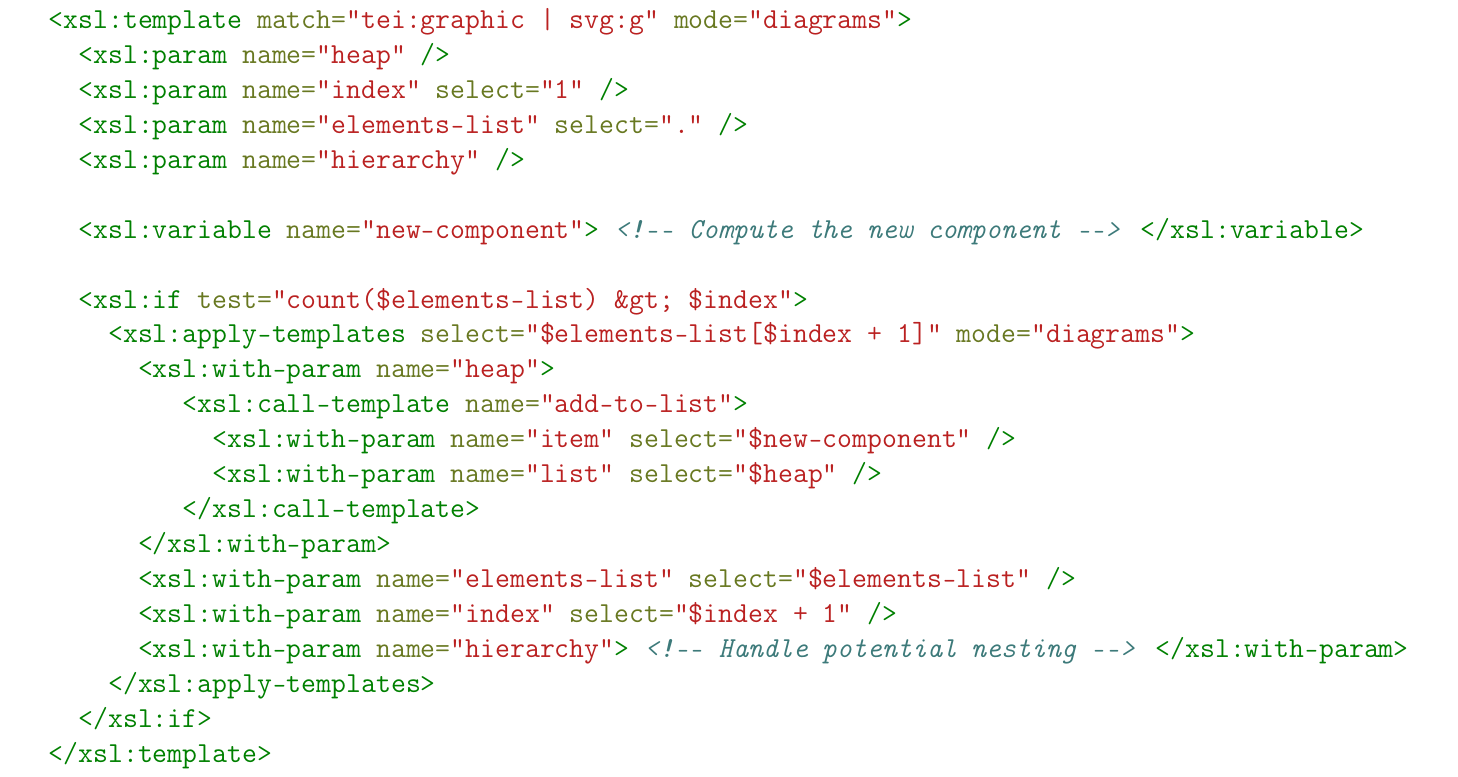
The program execution starts with the first instruction. To manage this instruction, we first need to parse the information available inside the instruction itself in order to prepare for the execution of the appropriate operation, and to update the processor's state according to this information.
Resolve addresses and execute the operation
The information required to execute an instruction is usually not fully contained in the instruction itself. Some of this information may already have been computed as a result of a previously executed instruction. In this case, the processor should find out where this information has been stored. Or, this information may have to be found elsewhere in the text. Then, the processor needs to locate the pieces of text containing the information, and try to decode them. The processor finally needs to make sure that all the parameters required to execute the instruction are indeed available (for instance, to trace a segment between two points requires that the beginning and the end of the line are two points whose position can be computed), before loading a sub-program able to execute the instruction.
Read operands
Once the different parameters of the operation have been identified, the processor loads the objects corresponding to each of these parameters. If necessary, the processor will execute the instructions needed to construct the aforesaid objects, then forward them to the sub-program charged to execute the main instruction.
Write the result
The processor then obtains the result of the sub-program, and stores it in an appropriate location. The different objects constructed will only be displayed in a consumable format (SVG, TikZ, STL, etc.) once the whole procedure has been executed.
Repeat
When an instruction has been executed and his results have been stored, the processor prepares the next instruction, and repeats until all the main program's instructions have been executed.