My academic curriculum and other training experiences.
> See more Image: Clément
 Description of my research activities
> See more Image:
 My activites in teaching, scientific mediation, etc.
> See more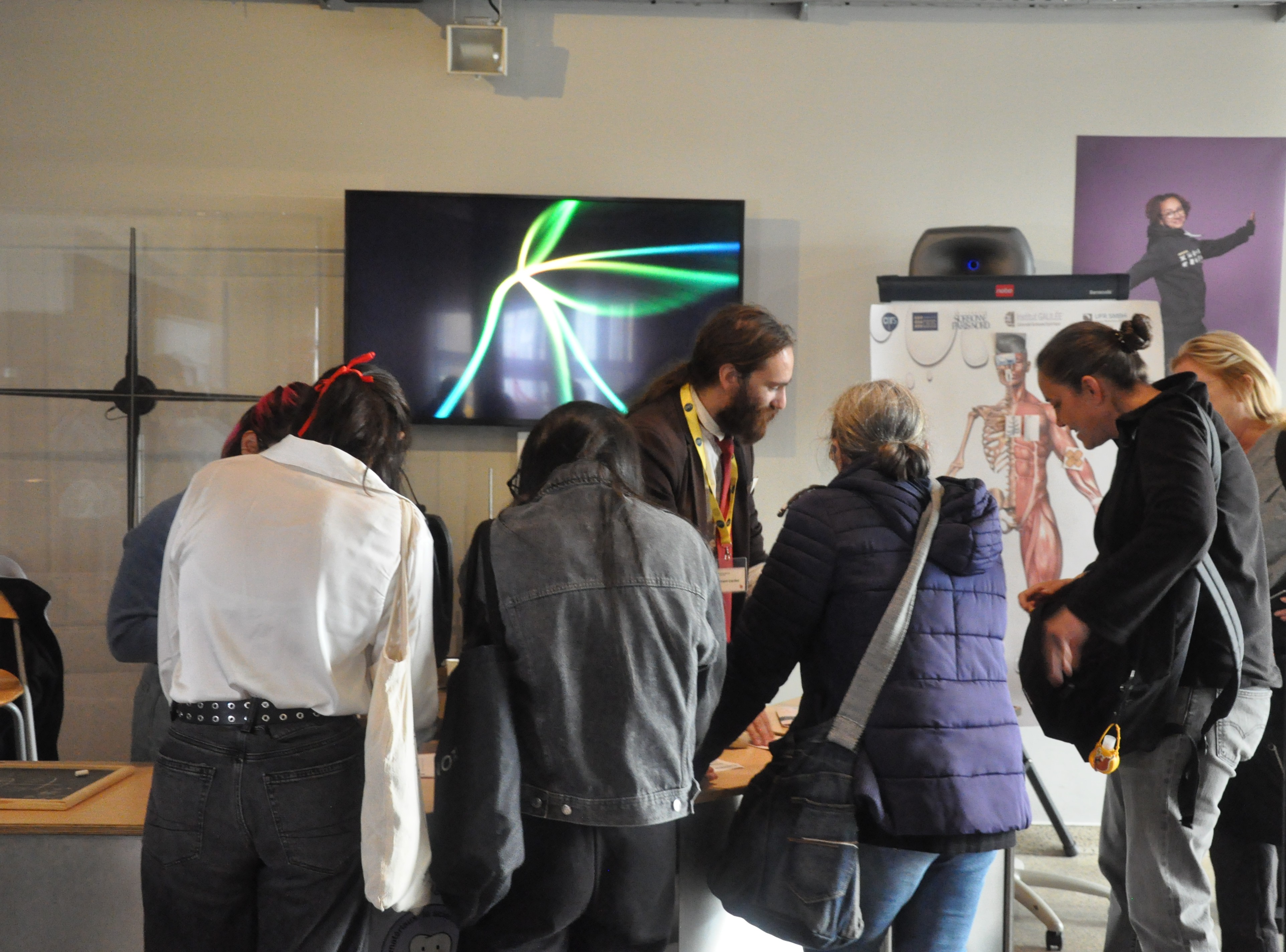 Image: Fanny Bernard,
10/11/25
Image: Fanny Bernard,
10/11/25
My academic curriculum and other training experiences.
> See moreDescription of my research activities
> See moreMy activites in teaching, scientific mediation, etc.
> See moreAfter an initial training, first in a double-bachelor program of mathematics and computer sciences in université Paris 7—Paris Diderot until the second year, then in the bachelor program of fundamental mathematics , I followed the History and Philosophy of Science master's program of the Université Paris Cité. I now prepare a PhD in History and Philosophy of Mathematics in the doctoral school 623—savoirs, sciences, éducation and in the SPHERE laboratory under the supervision of Agathe Keller and Matthieu Husson.
I took my master degree in the history and philosophy of science program in Université Paris Cité, focusing mainly on mathematics.
Since 2023, I have a PhD contract from the doctoral school 623—Savoirs, Sciences, Éducation. This allows me to focus mostly on y PhD research. As part of this contract, I also teach in the History and philosophy of science master program of Université Paris Cité, and I also take part in scientific popularization activities with the Mathematics unit of the Palais de la découverte.
As part of my master training, I got an internship in the History of astronomy team at the Observatoire de Paris.
This presentation will be the continuation of the one I gave in the same seminar in May 2026.
In an article published in 1998, Emmanuel Poulle and Denis Savoie showed that, untill the 17th century, almanacs and ephemerides printed in Latin were computing using parameters matching those found in the "Alfonsine Tables". These tables, copied in a (very) large number of manuscripts during the 14th century, were first pritned in Venice in 1483 by Erhard Ratdolt. In the following decades, three other printers chose to produce their own editions of the "Tables of King Alfonso" in the Republic: Johannes Hamman in 1492, Petrus Liechtenstein in 1518, and Luc'antonio Giunta in 1524. In this chapter, I study the editorial choices made in each of these four endeavrs. For each of them, I first try to identify which tables and which texts were included in the books. I then look at the typographical and paratextual features employed by the printer to tie these materials together. Finally, I analyse how these different elements are ordered in the bound books. All of this allows me to show an evolution in how actors and actresses who participated to these editions understood the core principles of "Alfonsine Astronomy" between the end of the 15th century and the beginning of the 16th century.
As part as my PhD contract, I carried out 2 teaching assignments of 32h "équivalent TD" inside the département histoire et philosophie des sciences of the Université Paris Cité, from 2024 to 2026. During this assignment, I got to take part into multiple teaching activities, including tutorial classes, or the organisation of the human sciences exam for the specific access pathway year for health training programs (PASS). But I mostly assumed full lectures for the master histoire et philosophie des sciencesmaster, on the following topics.
These two sessions of introduction to the history of mathematics were part of a larger class for the first year of the master's program. The first of the two took dealt with a controversy around the interpretation of Old Babylonian tablets, and used this as an opportunity to present the problems related to the edition of the texts, and the importance of archaeological contexts to understand the mathematical content of the text. The following session took this as a starting point to explore further the reconstitution of mathematical practices from texts in Chinese and in Sanskrit.
This whole semester class dealt with the History of Algebra. I was in charge for the first half of the semester, which dealt with everything from Antiquity until the Modern Period (c. 17th century). My part of the class was organised around the reading of sources in their original language (Akkadian, Chinese, Sansirkt, Arabic, Latin, French and German). These texts were selected as an opportunity to talk about issues of method, regarding how to deal with the archaeological context of the sources, the stakes related to the methods of edition, the way texts are read, and so on.
This session was part of a larger class dedicated to the topic of "Numbers and Magnitudes". The goal for this session was to show how sources related to the History of Astronomy could be used to study such a theme. I composed the lesson around a collection of documents from different periods and in different languages, which constituded multiple case studies. Students could then choose to write their final essay on an article which allowed them to dive deeper into one of the topics explored in the class.
I made this session in coordination with Haolin Wang 王浩霖 and Taro Tokutake 徳武 太郎. We presented an overview of multiple mathematical problems dealt in Sanskrit texts.
This class, made with Adeline Reynaud, was a general introduction to the history of sciences in the Ancient Middle East. It was composed around four themes: divination, medicine, mathematics and astronomy. These were used as case studies to explore the broader methodological question of characterising the role of "sciences" in ancient sources.
In addition to my teaching assignemnts, I also had a position of scientific mediation in the Mathematics unit of the Palais de la découverte in Paris, from 2024 until 2026. As part of this position, I presented animations in in relation with both Mathematics and History of Mathematics. Before the beginning of my PhD, I also worked from 2019 until 2023 with the association Planète sciences as scientific animator, and I sometimes worked for the Institut Henri Poincaré in Paris for specific events in 2018 and 2019.